How Much Paint Do I Need for a Room? Formula & Examples
Learn how to calculate paint for a room using wall area, doors and windows, coverage per coat, and number of coats. Includes a worked example.
Why accurate paint estimation matters
Paint is sold by volume — gallons in the United States, litres almost everywhere else — and every room you paint is a small estimating exercise. Buy too little and the job stops for a second trip; buy far too much and budget sits unopened. A measured estimate turns a store guess into a number you can defend.
This article walks through the standard method: measure the room, compute the gross wall area, subtract what will not be painted, divide by the manufacturer's coverage, multiply by the number of coats, then add a contingency. The walkthrough uses imperial units and a 12 ft × 12 ft room as the running example; metric builders can follow the same steps with metres and m² per litre. The result is a quantity, not a product specification.
The basic paint quantity formula
Four measurements drive the whole calculation: the room's length and width, the wall height, the area of doors and windows you will not paint, and the coverage rate printed on the can. Multiply and divide them in this order:
The coverage rate is the manufacturer's figure for how many square feet one gallon covers on one coat — a property of that product on a defined surface, not a universal constant. Everything before the division is geometry; everything after it is product behaviour.
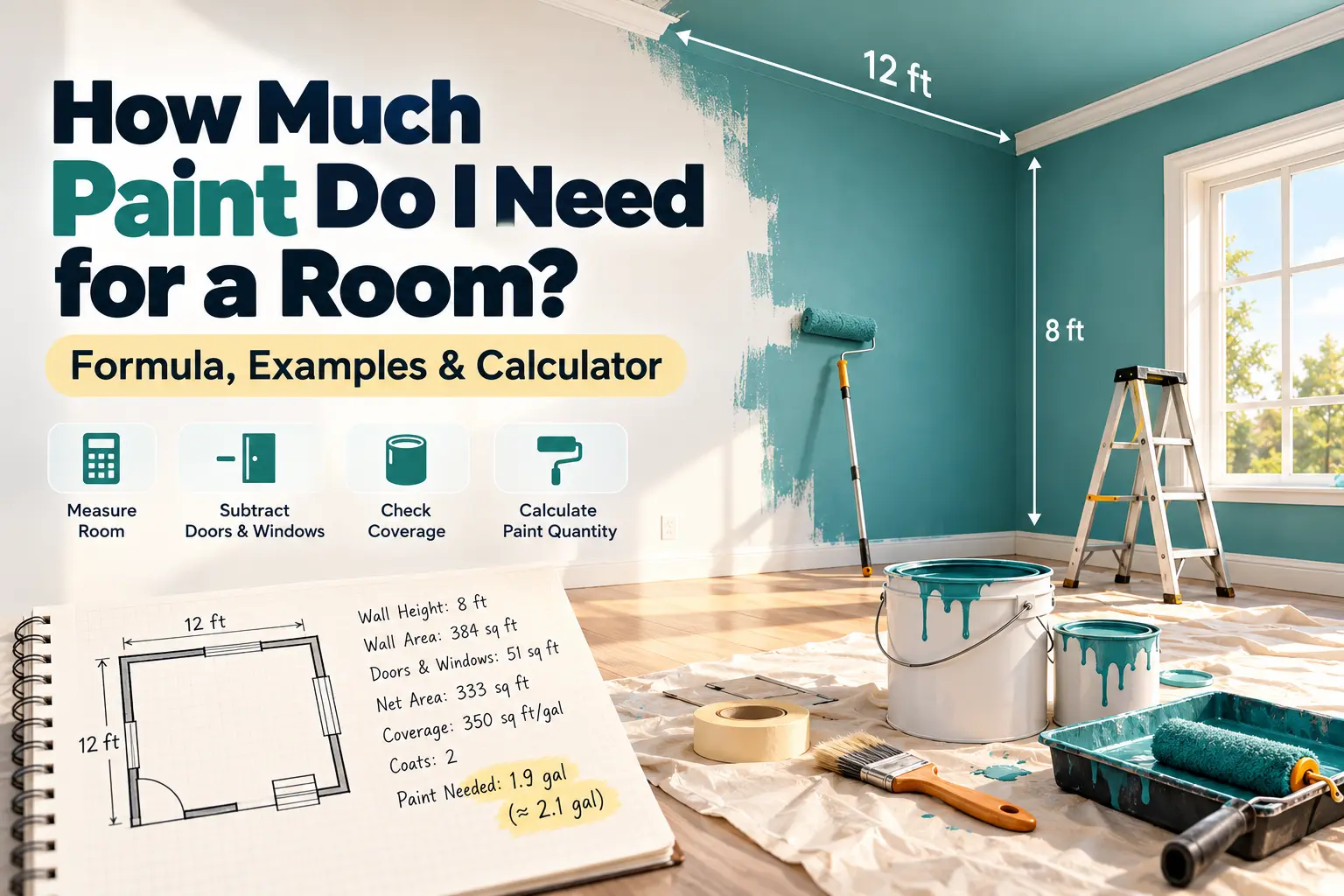
A 12 ft × 12 ft room with 8 ft walls has 384 sq ft of gross wall area. Deduct one door and two windows (51 sq ft here) and 333 sq ft remains. At an illustrative 350 sq ft per gallon per coat, two coats need 666 coated square feet — 1.90 gallons, or about 2.1 with an optional 10% allowance. Every figure is an example from stated inputs, not a standard for all paints.
Measuring length, width and wall height
Three tape measurements are enough: length and width along the floor from wall face to wall face, and wall height from the finished floor to the ceiling line. In older houses, measure twice and use the larger figure where walls are out of parallel.
- Measure at the wall faces rather than along the baseboard, which can stand proud of the drywall.
- Take the wall height at a few points; sagging ceilings are rarely uniform.
- Note alcoves, chases and built-in shelving separately; each flat wall section is its own rectangle.
- Record everything in one unit before any multiplication begins.
An L-shaped room is two rectangles, not a mystery. Measure each leg separately, compute its walls, and add the results. Only the perimeter you walk changes; the arithmetic stays the same.
Calculating the gross wall area
The walls of a rectangular room form a band around it. The length of that band is the perimeter, and multiplying it by the wall height gives the gross wall area — before any deductions:
The same shortcut works for any rectangle. A 10 ft × 10 ft room has a 40 ft perimeter and 320 sq ft of wall at 8 ft height; a 12 ft × 16 ft room has 56 ft and 448 sq ft.
| Room (L × W) | Perimeter | Gross wall area at 8 ft |
|---|---|---|
| 10 ft × 10 ft | 40 ft | 320 sq ft |
| 12 ft × 12 ft | 48 ft | 384 sq ft |
| 12 ft × 16 ft | 56 ft | 448 sq ft |
| 14 ft × 16 ft | 60 ft | 480 sq ft |
Corners consume no paint, so there is no adjustment for them. Ceilings are not part of this figure — they are measured separately, in section 9, because they are usually a different quantity and often a different sheen.
Deducting doors and windows
Openings you will not paint subtract from the gross area. Measure the frame of each door and window, not the glass alone. For planning a standard interior door is about 21 sq ft (3 ft × 7 ft) and a common window about 15 sq ft — typical example sizes that the MixTally Paint Calculator uses as overridable defaults. Measure your own openings whenever they differ.
The running example has one door and two windows:
- Deduct the full frame of doors and windows you will leave untouched.
- Do not deduct trim, baseboard or casings you intend to paint — leaving them in the calculation is the conservative choice.
- Painting the faces of doors is a separate small takeoff: a standard door face is about 13–15 sq ft each, so two faces add roughly 30 sq ft — about 0.17 gallons over two coats at the example coverage.
- Blinds, curtains and wall cabinets cover area too; deduct them only if they stay in place.
Understanding paint coverage per square foot
Every can states a coverage figure — square feet per gallon or square metres per litre — and that figure is the divisor in the final step of the formula. It describes how far one container spreads over one coat on a correctly prepared surface. It is a specification of that product, not a rule about paint in general: a dense acrylic on smooth drywall and a textured coating on bare plaster can differ widely.
| Surface (example) | Illustrative coverage per gallon per coat |
|---|---|
| Smooth, previously painted drywall | 300–350 sq ft |
| New or bare drywall | 225–300 sq ft |
| Lightly textured walls | 250–300 sq ft |
| Rough masonry or heavy texture | 150–250 sq ft |
The ranges above are planning examples, not manufacturer data — use them to sense-check your own can. Coverage falls when the surface drinks paint, when texture leaves hollows the roller cannot reach, and when deep colours require extra passes. It rises on sealed, lightly coloured surfaces with a quality roller.
A can that says 350 sq ft is not promising 350 sq ft of finished colour in one pass over an arbitrary wall. It is the rate for one coat on a defined surface. Two coats double the paint, not the covered area.
How much paint for two coats (or three)
Most finish work is specified at two coats, and the coverage rate applies to each of them. Multiply the net wall area by the number of coats before dividing:
On the running example (333 sq ft net), the coated area is 666 sq ft for two coats and 999 sq ft for three. At the illustrative 350 sq ft per gallon:
| Coats | Coated area | Gallons at 350 sq ft/gal |
|---|---|---|
| 1 | 333 sq ft | 0.95 |
| 2 | 666 sq ft | 1.90 |
| 3 | 999 sq ft | 2.85 |
First-coat primers do not belong in this multiplication. Primer is a separate product with its own coverage and quantity — the FAQ covers how it interacts with the finish estimate.
Worked example: a 12 × 12 ft room with 8 ft walls
The whole method, end to end. The inputs: a square room 12 ft on each side, 8 ft wall height, one standard door, two standard windows, two coats, and an illustrative coverage of 350 sq ft per gallon per coat.
Step 1: gross wall area
Perimeter = 2 × (12 + 12) = 48 ft, and gross wall area = 48 × 8 = 384 sq ft.
Step 2: deduct the openings
One door at 21 sq ft and two windows at 15 sq ft each give 21 + 30 = 51 sq ft of deductions, leaving a net wall area of 384 − 51 = 333 sq ft.
Step 3: coats and coverage
Two coats cover 333 × 2 = 666 sq ft. Dividing by the example coverage: 666 ÷ 350 = 1.90 gallons.
Step 4: optional allowance
Texture, absorption, cutting-in losses and a touch-up reserve are not in the geometric figure. An optional 10% allowance on 1.90 gallons is 1.90 × 1.10 = 2.09 gallons, which rounds to about 2.1 gallons.
| Quantity | Value |
|---|---|
| Room perimeter | 48 ft |
| Gross wall area | 384 sq ft |
| Door and window deductions | 51 sq ft |
| Net wall area | 333 sq ft |
| Coated area at two coats | 666 sq ft |
| Paint before allowance (350 sq ft/gal) | 1.90 gallons |
| Paint with optional 10% allowance | ≈ 2.1 gallons |
Paint is sold in whole containers, so 1.90 gallons is a two-gallon purchase and 2.1 gallons a three-gallon one if single gallons are all the shelf holds. Larger rooms often cross into five-gallon pails, where the arithmetic simply continues: divide, then round up.
350 sq ft per gallon, a 21 sq ft door and a 15 sq ft window were the stated inputs here. Your can, your openings and your wall surface will produce different numbers — the method is the constant, not the figures.
Estimating ceiling paint separately
Ceilings are flat planes measured in floor area, not perimeter. The ceiling of the same 12 ft × 12 ft room is 12 × 12 = 144 sq ft, and two coats need 288 coated square feet — about 0.82 gallons, realistically a one-gallon purchase.
Keeping the ceiling on its own line makes the estimate honest: ceilings are usually painted flat while walls carry the finish sheen, and a textured ceiling drinks more paint than a smooth one. Add the ceiling to the walls only when you total the shopping list, never into the wall-area formula.
Allowances for texture, absorption and touch-ups
The geometric calculation describes an ideal room with smooth, sealed walls and a roller that wastes nothing. Real work departs from that ideal at once in several directions, and an allowance acknowledges the gap.
- Surface texture: knockdown, orange peel and heavy roller naps leave hollows that take extra passes.
- Absorption: bare drywall, sanded plaster and raw concrete soak up a first coat that never quite hides.
- Application loss: paint stays in the tray, on the roller and in the cut bucket.
- Touch-ups: nicks from furniture, removed switch plates and the wall behind a door all call for a small reserve months later, when the original batch may be off the shelf.
A 5–10% allowance is a common planning choice for ordinary interiors; heavier texture or a first coat over bare surfaces can justify more. On the running example, 10% moves the walls from 1.90 to 2.09 gallons — cheap insurance against a second trip. Keep the allowance separate from the geometric result, so both numbers remain visible.
Common estimation mistakes
- Using the floor area as the wall area. A 12 × 12 floor is 144 sq ft; the walls of the same room are 384 sq ft before deductions.
- Forgetting that coats multiply everything. The coverage rate is per coat; two coats double the paint, not the painted area.
- Treating the coverage figure on the can as universal. A different sheen, colour or wall can shift it by a hundred square feet or more.
- Not deducting doors and windows — or deducting them twice by also removing door faces you plan to paint.
- Skipping the allowance, buying the exact geometric figure, then running short on the second coat.
- Mixing unit systems: litres into a gallon formula, or square metres into a square-feet coverage rate.
- Folding the ceiling into the wall area. The total looks similar, but it hides the separate quantity you must buy.
Frequently asked questions
- How much paint do I need for a 12 × 12 ft room?
- For the walls, about 1.9 gallons for two coats at an illustrative 350 sq ft per gallon after deducting one door and two windows; roughly 2.1 with a 10% allowance. The ceiling adds about one more gallon. Your can and your own openings will shift these figures.
- What is a typical paint coverage per square foot?
- Smooth, previously painted drywall often falls around 300–350 sq ft per gallon per coat; bare or textured surfaces less. Those are planning examples — the authoritative number is the coverage printed on the can.
- Do I deduct doors and windows from the wall area?
- Yes, for every opening you will not paint. Measure the frames (about 21 sq ft for a standard door, 15 sq ft for a common window here) and subtract them once. If you paint the door faces too, count that area separately.
- How much paint do I need for two coats?
- Double the coated area, then divide by coverage: 333 × 2 = 666 coated sq ft, and 666 ÷ 350 = 1.90 gallons before allowance.
- Should the ceiling be included in the wall area?
- No. Measure it separately as length × width (144 sq ft for the 12 × 12 room), multiply by its own coats, and add it to the shopping total. Ceilings are usually a different sheen and quantity.
- Does primer count as a coat of paint?
- No. Primer is a separate product with its own coverage and container size. Estimate it from the same wall area on its own line; the finish coats still need their full number of coats over it.
- How do I convert gallons and square feet to litres and square metres?
- One US gallon is about 3.785 litres, one square foot about 0.0929 square metres. Or use metric coverage directly: 333 sq ft is about 30.9 m², and at an example 8.5 m² per litre per coat, two coats need 61.8 ÷ 8.5 ≈ 7.3 litres — close to the imperial 1.90 gallons converted (≈ 7.2 litres); the gap is the example rates not being exact conversions.
Calculate the paint for your own room
The walkthrough above fixes one room size. For any other dimensions, the MixTally Paint Calculator takes length, width, wall height, door and window counts, coat number and your own coverage rate, then reports gross area, deductions, net area and the whole-container purchase in one pass. The full catalogue lives on the calculators directory page.
MixTally Paint Calculator
Enter room dimensions, doors, windows, coats and coverage to see wall area, deductions and paint quantity in gallons or litres, with an optional unit price for a cost estimate.
MixTally Paint Calculator