How Much Concrete Do I Need for a 10x10 Slab?
A 10x10 slab needs 1.23 cubic yards at 4 inches and 1.85 at 6 inches. See the full calculation, bag counts, waste allowance and delivery options.
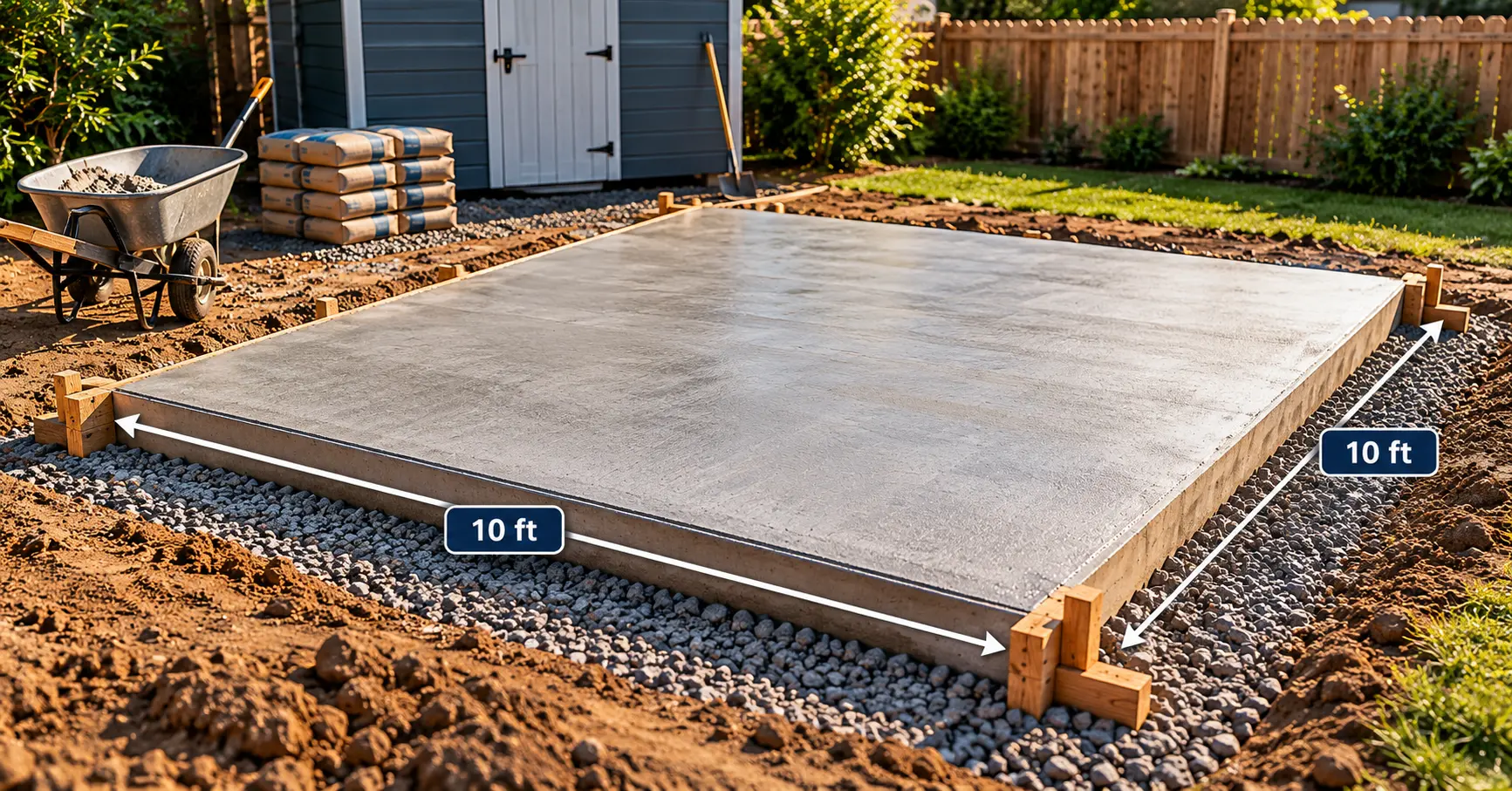
How much concrete does a 10x10 slab need?
A 10 ft × 10 ft slab at 4 inches thick is 33.33 cubic feet, which is 1.23 cubic yards. At 6 inches it is 50.00 cubic feet, which is 1.85 cubic yards. Those are exact geometric volumes before any allowance: at a 10% allowance the order becomes 36.67 cubic feet (1.36 cubic yards) and 55.00 cubic feet (2.04 cubic yards).
A 10 by 10 slab covers 100 square feet, which is 11.11 square yards of plan area. That figure never changes. Everything that follows comes from a single second input: the thickness of the slab. At 4 inches the slab is one third of a foot deep, so it holds 33.33 cubic feet of concrete. At 6 inches it is half a foot deep, so it holds 50.00 cubic feet. Six inches is one and a half times four inches, and the volume responds in exactly the same proportion.
Thickness is therefore not a detail to settle after the volume is calculated. It is the input that decides the order. Take it from the drawing or the specification, not from a default: a patio, a garage floor and a shed base can all be 10 ft × 10 ft and still need materially different quantities. The worked method behind every number on this page is set out in the companion article on calculating concrete volume for a slab, which covers the general formula in imperial and metric units.
Concrete Slab Calculator
Need a different slab size? Enter length, width, thickness and an allowance to get cubic feet, cubic yards, bag counts and an interactive 3D preview in either unit system.
Concrete Slab CalculatorHow to calculate the quantity
The calculation has five steps: measure the rectangle, convert the thickness into the same unit as the length and width, multiply to cubic feet, divide by 27 to reach cubic yards, then add an allowance for what the site will actually consume.
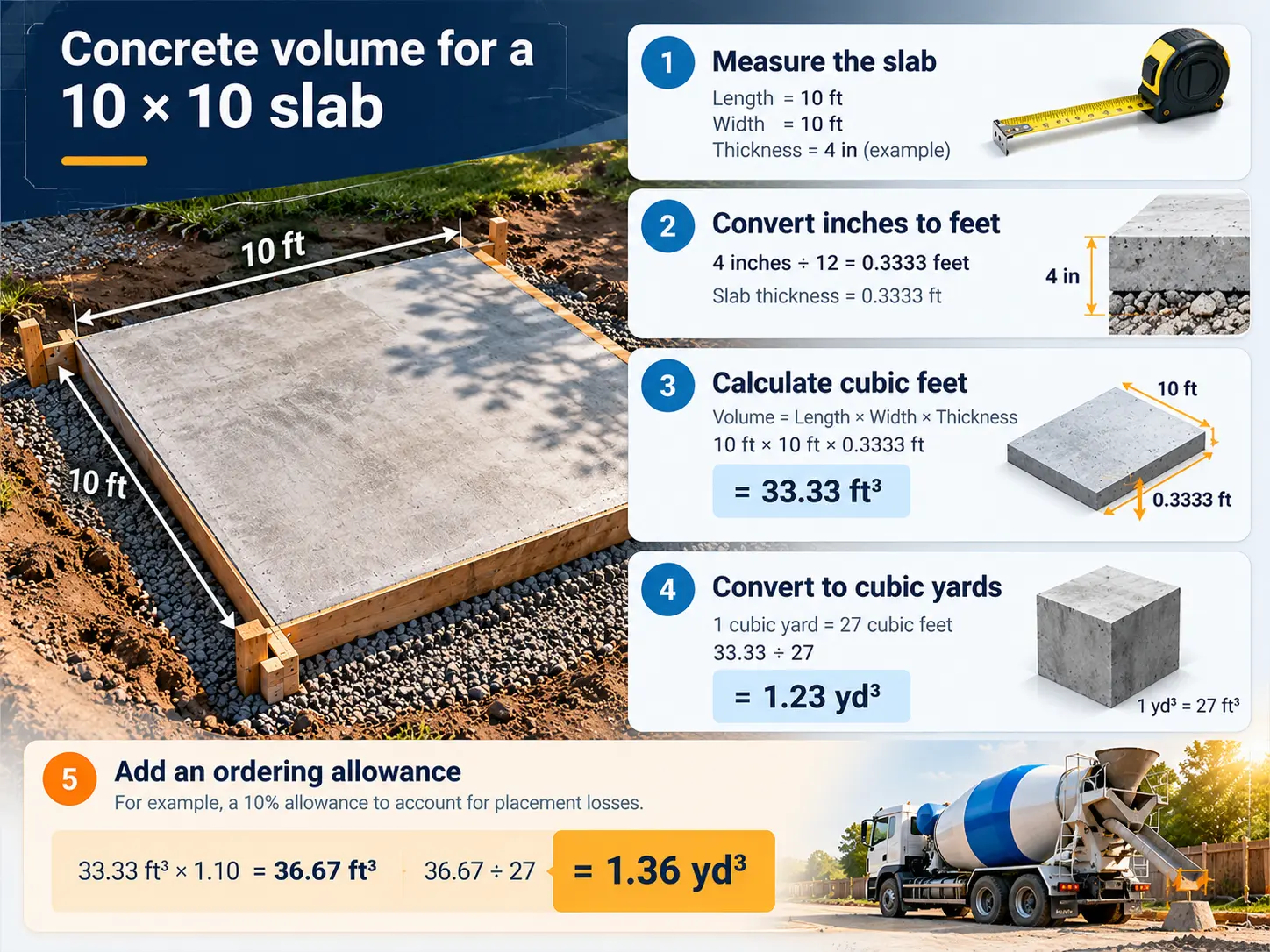
Step 1: measure the slab
Length and width are the outside face-to-face dimensions of the finished slab, both 10 ft here, giving a plan area of 100 square feet. Measure over the area the concrete will fill rather than over the formwork boards, and check the corners are square by comparing the diagonals: two equal diagonals confirm the rectangle is true.
Step 2: convert thickness to feet
Drawings annotate thickness in inches, so convert before multiplying. Four inches is 4 ÷ 12 = 0.33333 ft and six inches is 6 ÷ 12 = 0.50000 ft. Skipping this conversion is the classic factor-of-12 error: it returns 400 instead of 33.33, a figure twelve times too large.
Step 3: multiply to cubic feet
- Plan area: 10 × 10 = 100 ft²
- Thickness in feet: 4 ÷ 12 = 0.33333 ft
- Volume at 4 in: 100 × 0.33333 = 33.333 ft³
- Volume at 6 in: 100 × 0.50000 = 50.000 ft³
Step 4: convert to cubic yards
Ready-mix is dispatched by the cubic yard, so divide the cubic feet by 27. At 4 inches, 33.333 ÷ 27 = 1.2346 cubic yards, reported as 1.23. At 6 inches, 50.000 ÷ 27 = 1.8519 cubic yards, reported as 1.85. Keep the full precision through this division and round only the figures you write down, because rounding twice — once in cubic feet and again in cubic yards — quietly moves the answer.
Step 5: add the ordering allowance
The numbers above describe an ideal box with flat sides. Real slabs consume more than the ideal box, so a percentage allowance is applied before the figure is handed to a supplier or used to count bags.
| Thickness | Base (yd³) | +5% (yd³) | +10% (yd³) | +10% (ft³) |
|---|---|---|---|---|
| 4 in | 1.23 | 1.30 | 1.36 | 36.67 |
| 6 in | 1.85 | 1.94 | 2.04 | 55.00 |
Reporting 1.23 cubic yards and then treating it as the working value loses the 0.0046 cubic yards that rounding removed, and repeating that habit across several pours adds up. Carry 1.2346 through the allowance calculation and round the final order quantity once.
4 inches versus 6 inches
Both thicknesses describe the same footprint, so the comparison is purely proportional. Six inches of concrete is one and a half times four inches, which means 50.00 cubic feet against 33.33 cubic feet, 1.85 cubic yards against 1.23 cubic yards, and 28 more 80 lb bags.
| Thickness | Volume (ft³) | Volume (yd³) | 80 lb bags | 60 lb bags |
|---|---|---|---|---|
| 4 in | 33.33 | 1.23 | 56 | 75 |
| 6 in | 50.00 | 1.85 | 84 | 112 |
| Difference | +16.67 | +0.62 | +28 | +37 |
The extra 0.62 cubic yards is rarely the deciding factor on its own, but it is the difference between one order strategy and another, and it is the difference between a slab that matches the drawing and one that does not. Choose the thickness from the intended use and the structural specification; the quantity calculation simply reports what that choice costs in material.
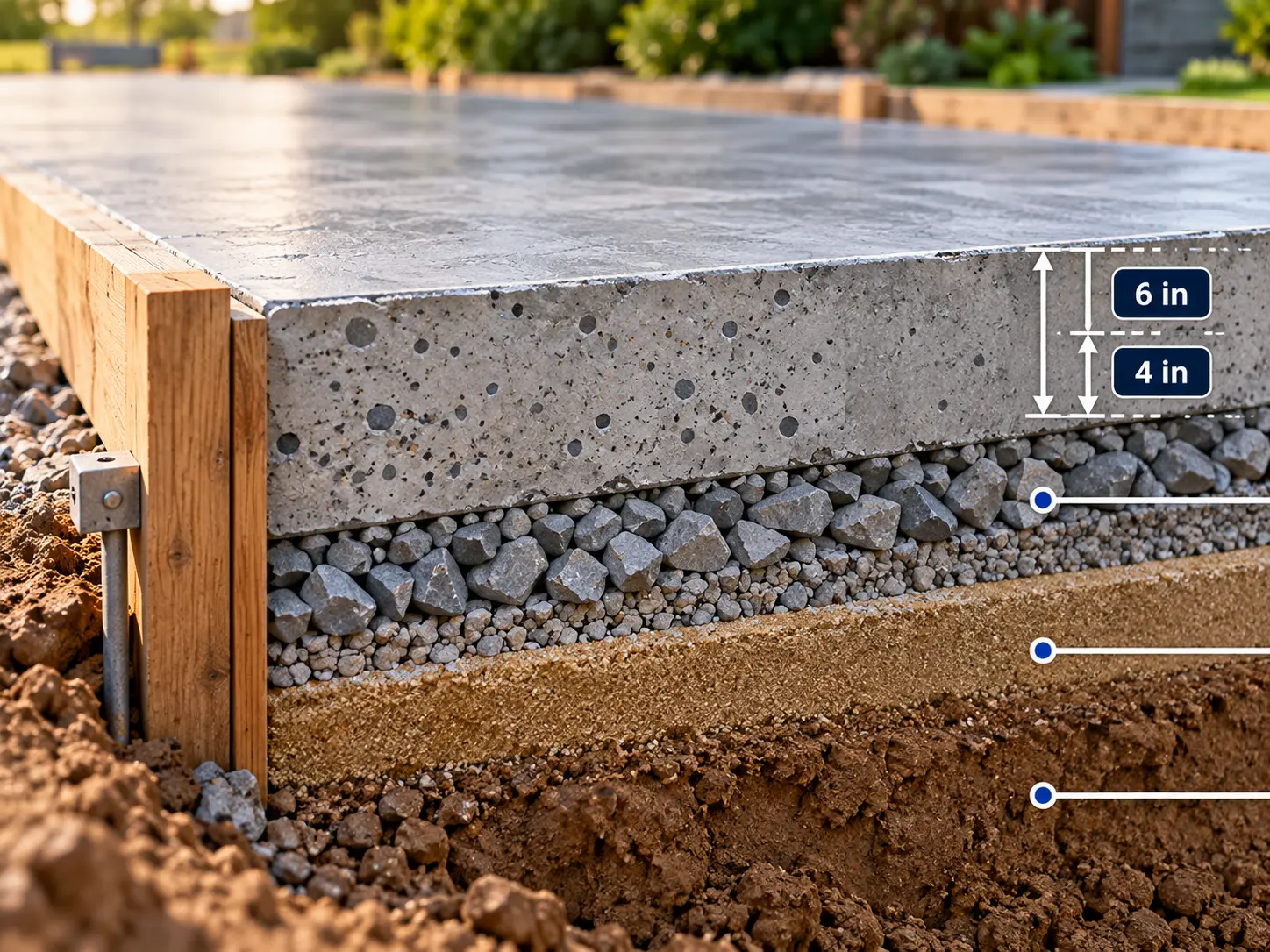
Bagged concrete: counting 80 lb and 60 lb bags
Bagged mix is bought by the bag rather than by volume, so the volume has to be divided by the yield of a single bag and always rounded up. An 80 lb bag yields 0.60 cubic feet of wet concrete and a 60 lb bag yields 0.45 cubic feet — the same figures the MixTally calculator uses, and the yields published for QUIKRETE bagged concrete.
An 80 lb bag gives 0.60 ft³; a 60 lb bag gives 0.45 ft³.
| Bag size | Yield (ft³) | Bags per yd³ | At 4 in | At 6 in |
|---|---|---|---|---|
| 80 lb | 0.60 | 45 | 56 | 84 |
| 60 lb | 0.45 | 60 | 75 | 112 |
The arithmetic for the 4 inch slab is 33.333 ÷ 0.60 = 55.6, which rounds up to 56 bags; with 60 lb bags it is 33.333 ÷ 0.45 = 74.1, which rounds up to 75. Per cubic yard the counts are exact: 27 ÷ 0.60 = 45 eighty-pound bags and 27 ÷ 0.45 = 60 sixty-pound bags. Applying the allowance before dividing changes the totals to 62 and 82 bags at 4 inches, and 92 and 123 bags at 6 inches.
Dividing the reported 1.23 cubic yards by 0.60 gives a meaningless number, and converting that 1.23 back to cubic feet gives 33.21 instead of 33.33. Count bags from the unrounded cubic feet so the rounding happens once, at the bag boundary.
Ready-mix or bagged concrete
A quantity between 1.23 and 2.04 cubic yards sits where both delivery routes are realistic. Bagged mix lets you buy exactly the count the calculation produces and keeps any unopened bags for later. Ready-mix is batched by volume at the plant, arrives ready to discharge, and usually carries a supplier minimum for small loads, so confirm what applies before assuming the calculated figure is the quantity you will be charged for.
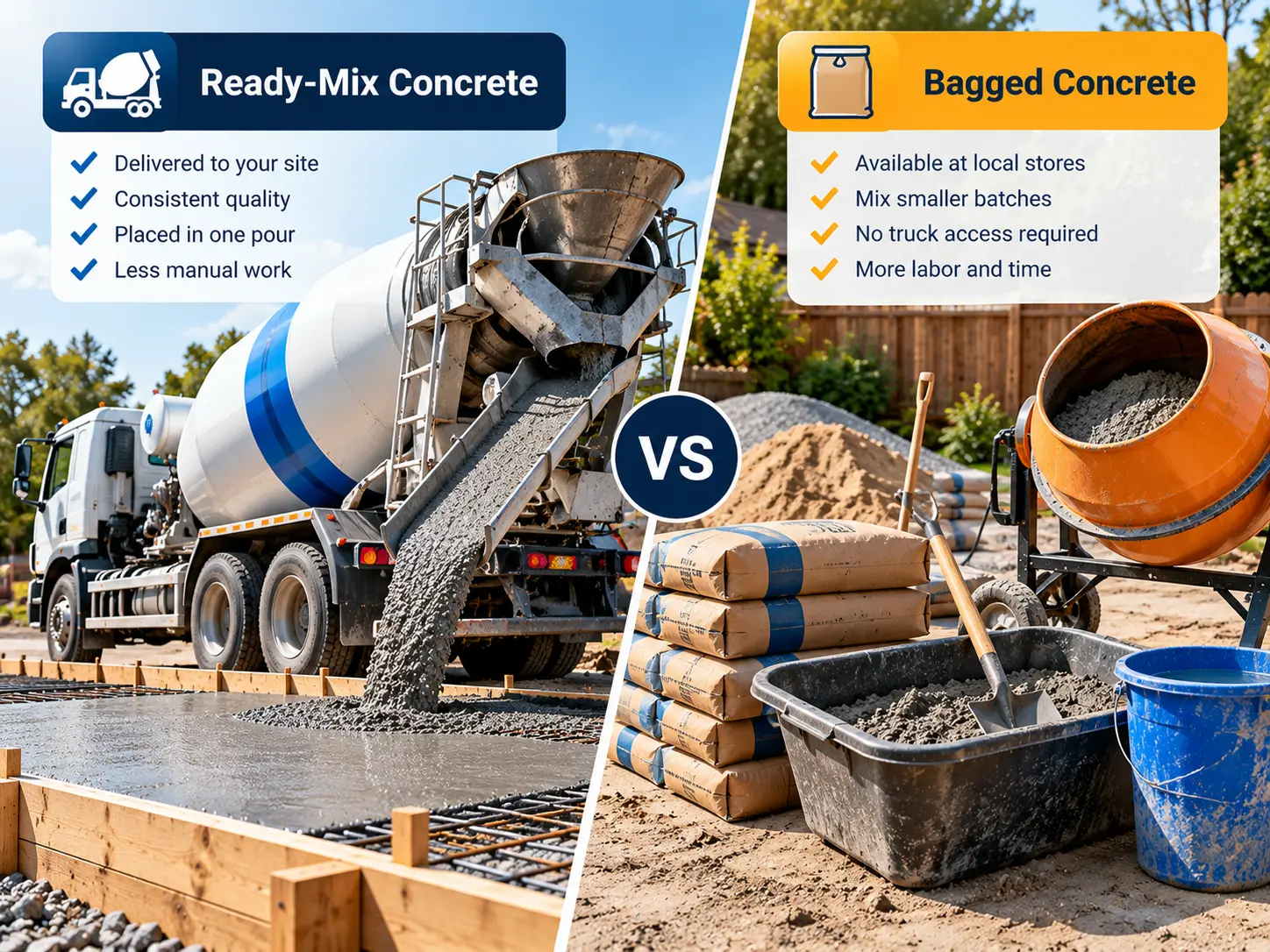
| Consideration | Ready-mix | Bagged mix |
|---|---|---|
| Order unit | Cubic yards from the calculation | Individual bags from the bag count |
| Small pours | Subject to a supplier minimum | Buy exactly what is needed |
| Handling | Delivered and discharged into the form | Mixed, carried and placed by hand |
| Storage | Must be placed in one session | Unopened bags keep if stored dry |
| Mixing | Batched at the plant | Mixed on site, so water control matters |
Whichever route is chosen, the quantity does not change. The volume of a 10 ft × 10 ft slab is a property of its geometry; delivery only changes how that volume is bought, carried and placed.
Ordering allowance: what to hand over
An ordering allowance covers the gap between the ideal rectangle and the slab that gets built. How large it should be depends on the site rather than on a universal rule, which is why the calculator exposes a 0–20% slider with 10% as its starting point.
- A subgrade cut slightly low, so concrete fills more depth than the drawing shows.
- Forms that spread or sit out of level under the pressure of the pour.
- A base that is not perfectly flat, leaving low spots that consume extra volume.
- Spillage, chute loss and material left in the mixer at the end of the pour.
- Finishing, screeding and working around edges and penetrations.
- A supplier minimum that rounds a small order up regardless of the calculation.
Worked through on the 4 inch slab, a 10% allowance moves the order from 33.33 cubic feet to 36.67 cubic feet, from 1.23 cubic yards to 1.36 cubic yards, and from 56 bags of 80 lb mix to 62. Ordering the exact geometric volume risks running short partway through the pour, where a second batch means a cold joint; ordering far beyond what the site needs wastes budget and leaves material to dispose of. Record the allowance you chose and why.
Frequently asked questions
- How much concrete is in a 10 ft × 10 ft slab at 4 inches?
- 33.33 cubic feet, which is 1.23 cubic yards, before any allowance. With a 10% allowance the order becomes 36.67 cubic feet, or 1.36 cubic yards.
- How much concrete is needed at 6 inches?
- 50.00 cubic feet, which is 1.85 cubic yards. That is exactly 1.5 times the 4 inch slab, because 6 inches is 1.5 times 4 inches.
- How many bags of concrete do I need?
- At 4 inches: 56 × 80 lb or 75 × 60 lb with no allowance, and 62 × 80 lb or 82 × 60 lb at 10%. At 6 inches: 84 × 80 lb or 112 × 60 lb with no allowance, and 92 × 80 lb or 123 × 60 lb at 10%.
- Should I order exactly the calculated volume?
- No. The calculated figure is the volume of an ideal box. Real pours lose or gain volume through subgrade variation, form deflection and handling, so add an allowance you have chosen for your own site and check whether a supplier minimum applies.
- Which is cheaper, ready-mix or bagged concrete?
- It depends on local bag prices, the supplier price per cubic yard and any short-load minimum. Compare the cost of the exact bag count against the delivered price including that minimum, and weigh in the labour of mixing bags by hand.
Calculate your own concrete quantity
The figures above are specific to 10 ft × 10 ft at two thicknesses. For any other rectangle, enter the dimensions and the allowance into the calculator and read off the base volume, the order volume, the cubic yards, the cubic feet and both bag counts side by side.
MixTally Concrete Slab Calculator
Imperial or metric, a 0–20% allowance slider and bag counts for 80 lb and 60 lb mixes, with the geometric volume kept separate from the order quantity.
MixTally Concrete Slab Calculator