How to Calculate Concrete Volume for a Slab
Learn the concrete slab volume formula, work through imperial and metric examples, convert cubic feet to cubic yards, and choose an ordering allowance.

When and why you calculate slab volume
Concrete is bought by volume: cubic yards in imperial projects, cubic metres in metric ones. You need that number before a pour for three practical reasons. First, ready-mix suppliers quote and dispatch by volume, so an order cannot be placed without it. Second, bagged mix is sold in fixed bag sizes, and bags can only be counted once the volume is known. Third, a volume figure is the only way to sanity-check a takeoff against the slab you can actually see on site.
The calculation is pure geometry. It takes the dimensions of a rectangular prism and multiplies them. It does not tell you whether the slab is thick enough, whether it needs reinforcement, or whether the subgrade will carry the load. Those are design questions that belong on the drawing, not in a volume formula. This article computes quantity only, and every result below should be read as a quantity, not as an engineering approval.
The concrete volume formula
A rectangular slab is a box. Volume is length multiplied by width multiplied by thickness:
V is the volume, L the length, W the width and T the thickness. The only rule that matters is unit consistency: all three inputs must be expressed in the same unit before you multiply. Mixing units is the single most common source of order errors, and it is always a factor-of-12 mistake in imperial work.
How to measure length, width and thickness
Length and width come from the plan area of the slab. Measure the outside face-to-face dimensions of the finished rectangle, or take them from the drawing if one exists. Where the slab has cut-outs, steps or curves, split it into rectangles, calculate each one separately and add the results together.
- Measure length and width with a tape over the area the concrete will actually occupy, not over the formwork exterior.
- Check the corners are square by comparing diagonals; unequal diagonals mean the plan area is not the rectangle you measured.
- Take thickness from the specification or drawing rather than from a guess, and confirm it against the depth of the forms on site.
- Where thickness varies across the slab, calculate each thickness zone separately and add the volumes.
Measure the form depth to catch mistakes, but calculate with the thickness the drawing calls for. Measuring an uneven subgrade at its deepest point and using that single number everywhere will overestimate the pour.
Unit conversion: inches, feet, millimetres and metres
Imperial slab dimensions are usually entered as length and width in feet but thickness in inches, because that is how drawings are annotated. Metric drawings are no different: lengths in metres, thickness in millimetres. Convert before multiplying.
| Quantity | Conversion | Exact? |
|---|---|---|
| 1 foot | 12 inches | Yes |
| 1 inch | 25.4 millimetres | Yes |
| 1 foot | 0.3048 metres | Yes |
| 1 cubic foot | 0.0283168 cubic metres | Yes |
| 1 cubic yard | 27 cubic feet | Yes |
| 1 cubic yard | 0.764555 cubic metres | Rounded |
| 1 cubic metre | 35.3147 cubic feet | Rounded |
| 1 cubic metre | 1.30795 cubic yards | Rounded |
Multiplying 10 ft × 10 ft × 4 without dividing the 4 by 12 gives 400 instead of 33.33 cubic feet — twelve times too much. If an answer looks implausible against the slab in front of you, check the thickness unit first.
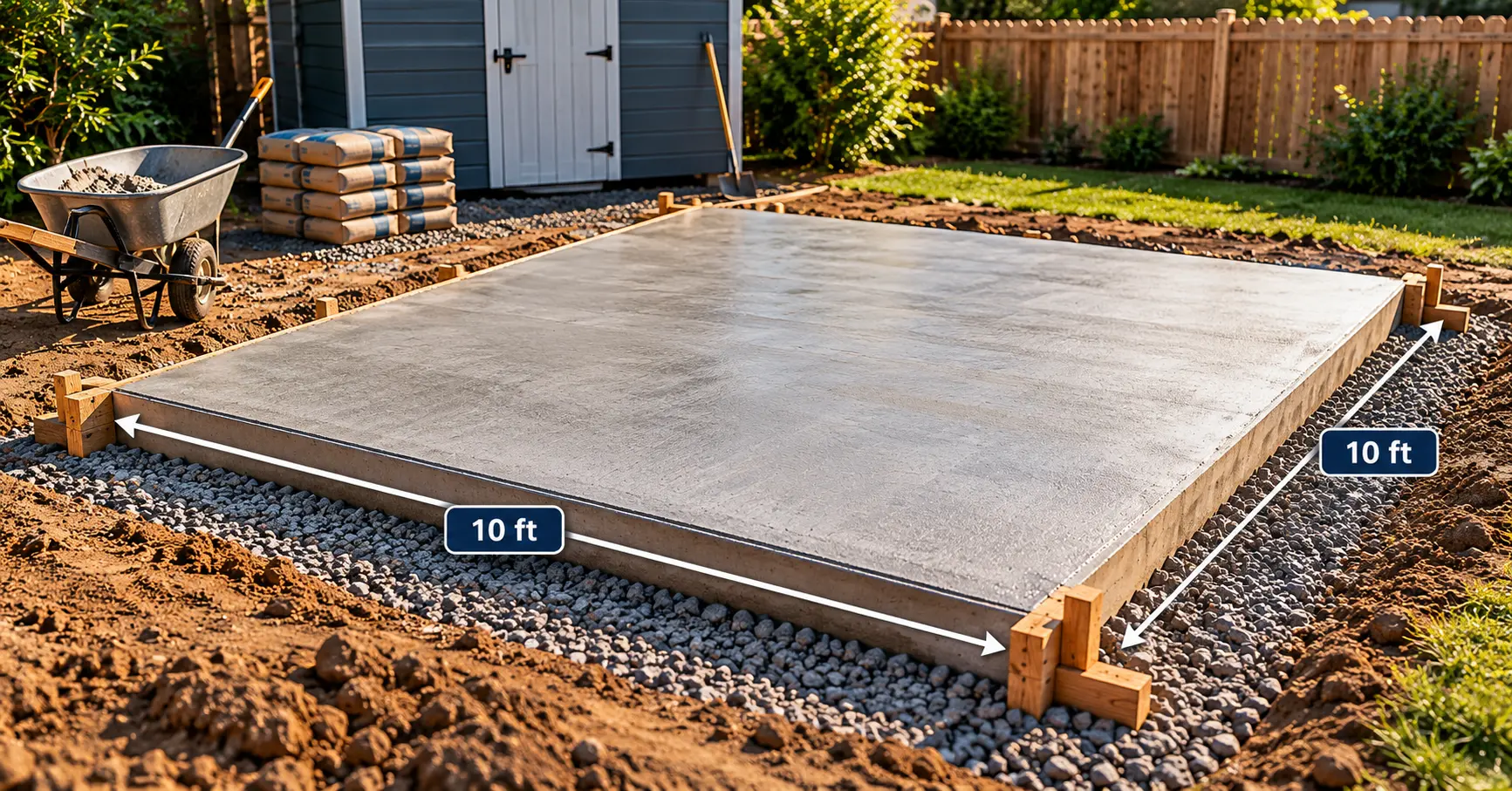
Worked example: a 10 ft × 10 ft slab at 4 inches
Take a 10 foot by 10 foot slab specified at 4 inches thick. Convert the thickness, multiply, then convert the result into the unit concrete is sold in.
- T (ft) = 4 ÷ 12 = 0.33333 ft
- V = 10 × 10 × 0.33333 = 33.333 ft³
- V (yd³) = 33.333 ÷ 27 = 1.2346 yd³
- Rounded for reporting: 33.33 ft³ ≈ 1.23 yd³
That 1.23 cubic yards is the exact geometric volume of the box. It is the correct answer to "how much space does this slab occupy", and it is not yet the number you should hand to a supplier. Section 8 deals with the difference.
Metric worked example
Now the same job drawn in metric units: a 3.05 m by 3.05 m slab specified at 100 mm thick. Convert the thickness to metres first, then multiply.
- T (m) = 100 ÷ 1000 = 0.100 m
- V = 3.05 × 3.05 × 0.100 = 0.93025 m³
- Rounded for reporting: 0.930 m³
The two examples are close but deliberately not identical: 3.05 m is 10.007 ft and 100 mm is 3.937 in, so the metric slab is slightly smaller. Keeping the same job exactly equivalent gives 3.048 m × 3.048 m × 0.1016 m = 0.94389 m³, which converts back to 33.333 ft³ — the imperial answer to the digit. If your two unit systems disagree beyond that, one of them has a conversion error.
Converting cubic feet, cubic yards and cubic metres
Volume conversions are one step once the geometry is done. Ready-mix in the United States is dispatched in cubic yards, bagged mix is quoted in cubic feet, and metric projects are supplied in cubic metres.
- Cubic feet to cubic yards: divide by 27.
- Cubic yards to cubic feet: multiply by 27.
- Cubic feet to cubic metres: multiply by 0.0283168.
- Cubic metres to cubic feet: multiply by 35.3147.
- Cubic metres to cubic yards: multiply by 1.30795, or divide by 0.764555.
For the imperial example, 33.333 ft³ ÷ 27 = 1.2346 yd³, and 1.2346 yd³ × 0.764555 = 0.94389 m³. Bagged concrete is a separate conversion: an 80 lb bag yields roughly 0.60 ft³ of wet concrete, so 33.333 ÷ 0.60 = 55.6, which rounds up to 56 bags. The same figure works out at about 45 eighty-pound bags per cubic yard, since one cubic yard is 27 ft³.
Ordering allowance: volume is not the order quantity
The number produced by V = L × W × T is the geometric volume of an ideal rectangle. A real pour is never ideal, and the gap between the two is what an ordering allowance covers. How large that gap is depends on the site, which is why there is no single percentage that is correct for every job.
- Subgrade that is cut low or over-excavated, so concrete fills more depth than the drawing shows.
- Formwork that spreads, bows or sits out of level under the hydrostatic pressure of the pour.
- A subbase that is not flat, leaving low spots that consume extra volume.
- Spillage, chute loss and pump priming that never reaches the form.
- Waste from finishing, screeding and working around penetrations and edges.
- Supplier minimums: a small slab may be rounded up simply because short loads carry a minimum charge.
Select an allowance from your own site conditions and record why you chose it. The MixTally Concrete Slab Calculator exposes a 0–20% allowance slider and shows the base volume, the added volume and the final order side by side, so the geometric figure and the ordered figure are never confused with each other.
Two errors sit at opposite ends of this decision. Ordering exactly the geometric volume risks a shortfall partway through the pour, where a second delivery means a cold joint. Ordering far beyond what the site needs wastes budget and leaves material to dispose of. The correct allowance is the one you can justify for the conditions in front of you.
Common calculation mistakes
- Leaving thickness in inches while length and width are in feet. Always divide the thickness by 12 first.
- Rounding intermediate results. Keep full precision through the multiplication and round only the final figure.
- Mixing unit systems in one calculation — metres with feet, or centimetres with inches.
- Using the plan area of the whole footprint when the slab is actually several rectangles at different thicknesses.
- Ordering the geometric volume and nothing more, or applying the same allowance twice — once by hand and once inside the calculator.
- Ignoring slopes, crowns and thickened edges. A flat-slab formula underestimates any slab that is not a flat rectangle.
- Comparing an answer from one unit system with an answer from another without converting both to the same unit first.
Frequently asked questions
- How much concrete is in a 10 ft × 10 ft slab at 4 inches?
- 33.33 cubic feet, which is 1.23 cubic yards, before any ordering allowance. Multiply by 1.10 for a 10% allowance and the figure becomes 1.36 cubic yards.
- How many 80 lb bags does that slab need?
- An 80 lb bag yields about 0.60 cubic feet, so 33.33 ÷ 0.60 = 55.6, which rounds up to 56 bags. Equivalently, one cubic yard needs about 45 eighty-pound bags.
- What is the formula in metric units?
- V (m³) = length (m) × width (m) × thickness (m). If the thickness is given in millimetres divide it by 1000 first, or by 100 if it is given in centimetres — the same convention the calculator uses.
- How thick should a concrete slab be?
- Thickness is set by the drawing and the intended use of the slab, and this article deliberately does not prescribe one. Enter whatever thickness the specification calls for; the volume formula only needs the number to be consistent with your other units.
- Should I order exactly the calculated volume?
- No. The calculated figure is the geometric volume of an ideal box. Real pours lose volume to subgrade variation, form deflection and handling, so add an allowance you have chosen for your own site conditions, and check whether the supplier applies a short-load minimum.
Run the numbers in the calculator
Concrete Slab Calculator
Enter length, width, thickness and an allowance to see base volume, cubic yards, cubic feet, bag counts and an interactive 3D slab — in imperial or metric units.
Concrete Slab Calculator